
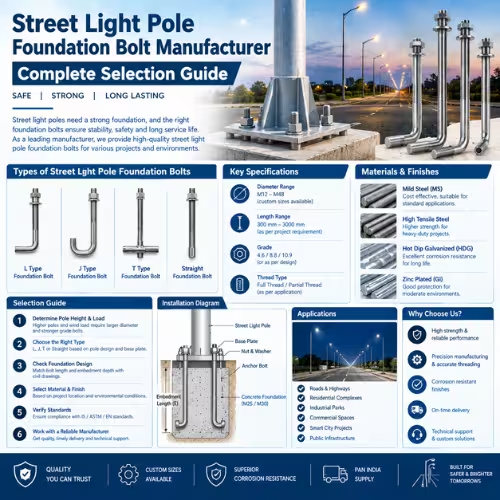
Street Light Pole Foundation Bolt Manufacturer: Complete Selection Guide
A street light pole may look simple after installation, but the connection between the pole base plate and concrete foundation is an important part of the overall system. Foundation bolts provide the mechanical connection required to secure the pole assembly to its foundation. For infrastructure contractors, electrical contractors and pole manufacturers, choosing the right street light pole foundation bolt manufacturer is essential because bolt dimensions, configuration and material must match the approved foundation and pole design.
What Are Street Light Pole Foundation Bolts?
Street light pole foundation bolts are anchor bolts installed within a concrete foundation and used to secure a pole base plate.
Depending on the design, foundation bolts may be straight, bent or fabricated into configurations such as J-type or other project-specific shapes. The bolt pattern must correspond accurately with the holes in the pole base plate.
Why Are Foundation Bolts Important?
Foundation bolts transfer forces between the pole base assembly and its foundation.
A street light installation may be exposed to:
- Wind loads
- Vibration
- Environmental exposure
- Pole and luminaire loads
- Installation stresses
- Long-term corrosion conditions
The foundation bolt arrangement therefore needs to be designed and manufactured according to the engineering requirement.
J Type Foundation Bolts for Street Light Poles
J-type foundation bolts are frequently considered for embedded foundation applications because the bent section provides anchorage within the concrete. The exact shape, bend radius, diameter, embedment length and exposed threaded length should be determined from the project design. A manufacturer should not select dimensions only from the pole height. The foundation design and bolt drawing are equally important.
Key Foundation Bolt Specifications
Bolt Diameter: The diameter should be based on the engineering design and required load capacity.
Overall Length: The total bolt length includes the embedded portion and exposed threaded portion. Both dimensions should be checked carefully.
Thread Length: The exposed thread should provide sufficient engagement with the required nuts and washers.
Bolt Configuration: J, L, T, plate-type and other configurations may be selected according to the foundation design.
Material: The material and mechanical properties should meet the project specification.
Surface Protection: For outdoor infrastructure, corrosion protection deserves particular attention. Hot-dip galvanized foundation bolts can be considered where the project requires zinc protection against environmental exposure.
Hot-Dip Galvanized Foundation Bolts
Galvanizing is particularly relevant to outdoor infrastructure because foundation bolts may be exposed to moisture, soil conditions and weather during their service life. The required coating specification should be agreed before production. Buyers should also consider how coating affects threads, nuts and installation.
Nuts and Washers
A foundation bolt should not be considered separately from its connection hardware.
The assembly may include:
- Hex nuts
- Heavy-duty nuts
- Plain washers
- Plate washers
- Special washers
- Locking arrangements where specified
Washer dimensions should be compatible with the base plate and bolt arrangement.
Why Dimensional Accuracy Matters
Imagine a pole arriving at the site with a base plate whose hole pattern does not match the foundation bolts. The result can be expensive site modification. Accurate fabrication therefore matters in:
- Bolt spacing
- Bolt diameter
- Projection
- Thread length
- Bend location
- Bolt pattern
- Overall dimensions
For projects with repetitive pole installations, consistency between batches becomes especially important.
Common Applications
Street light foundation bolts can be used for:
- Highway lighting
- Urban street lighting
- Industrial roads
- Parking areas
- Commercial developments
- Residential developments
- Infrastructure projects
- Road medians
- High-mast and lighting structures, subject to design
How to Order Foundation Bolts
Send the manufacturer:
- Foundation bolt drawing
- Bolt diameter
- Overall length
- Embedment length
- Thread length
- Bolt type
- Bolt spacing
- Material grade
- Coating requirement
- Nut and washer details
- Quantity
A drawing is particularly useful because foundation bolt requirements can differ significantly between projects.
Why Choose a Manufacturer Instead of Generic Stock?
Generic stock may not match the exact dimensions required by a project. A manufacturer can produce the required configuration based on an approved drawing and quantity.
This is especially useful for:
- Large infrastructure projects
- Repetitive pole installations
- Customized pole designs
- High-volume procurement
- Projects requiring specific coatings
Standards and Project Specifications
Foundation bolt requirements should be checked against the applicable project specification and relevant standards. ASTM F1554, for example, covers steel anchor bolts used for anchoring structural supports to concrete foundations, including street lighting and traffic-signal applications. For Indian projects, the applicable Indian Standards and project-specific engineering drawings should be confirmed before manufacturing.
Conclusion
Street light pole foundation bolts are a critical connection component rather than a generic hardware item. Correct diameter, length, configuration, thread, material, coating and bolt spacing all contribute to a successful installation. Working with a manufacturer that can understand drawings and produce project-specific foundation bolts can help reduce site problems and improve procurement consistency.
Frequently Asked Questions
Which foundation bolts are used for street light poles?
The exact type depends on the pole and foundation design. J-type, L-type and other fabricated anchor bolt configurations may be specified.
Can foundation bolts be galvanized?
Yes. Galvanized foundation bolts can be manufactured where corrosion protection is required.
What information is required to manufacture street light foundation bolts?
Diameter, length, thread length, bend configuration, material, coating, bolt spacing, quantity and drawing details are commonly required.
Why are washers required with foundation bolts?
Washers distribute the clamping force over a larger area and help provide an appropriate bearing surface beneath the nut.
Can Royal Anchors manufacture customized foundation bolts?
Project-specific foundation bolts can be manufactured according to approved dimensions and drawings.
